Posts

DESMA 9 Event 5 ---- Fowler Museum

Image
Last week I visited the Fowler Museum on campus. I had a great time and I am thankful that this class coaxed me to go or else I may never have gone. I think this museum will definitely benefit a student of DESMA 9 because you can see both how ancient and medical technology can be incorporated into art.  I will definitely be going back in the future! While I enjoyed looking through all the exhibits, I think only a few truly applied to the concepts of the course.  I now want to show you a few pieces of art that I found especially applicable. The first is a mannequin with the spine exposed and no head included. I thought this was an interesting crossover between medicine and art. Just as Dr. Vesna stated in her lecture, dissection was the first connection between these two realms of study. This work uses dissection for a purely artistic purpose. The folded out torso exposing the spine conjures ideas of how simple humans are: just skin wrapped around a vertebral column....

DESMA 9 Event 4 ---- Hammer Museum

Image
Below are photos from a Hammer exhibit of Heatherwick Studio's London-based designs.  Founded in 1994 by British designer Thomas Heatherwick, the studio now has 160 architects, designers, and makers.  International recognition was acquired for this studio after plans for the Rolling Bridge (directly below). This bridge is awe-inspiring for its modernistic beauty while unrolled, by which pedestrians can cross the inlet behind Paddington Station, and its perplexing ability to fold like a roll-polly, allowing boats to pass through.  The description plaque beside the small blueprint plan of the bridge (pictured below) states that it combines "Both infrastructure and public art...[and] captivates onlookers with its engineering and advances Britain's drawbridge tradition".  Above is an innovative plan for a biomass power station on the Tees River that will serve 2,000 new houses, but with a cultural function and an elegant form.    I think that ...

DESMA 9 Week 9 Blog

Image
    I found Dr. Vesna's summary of Space in popular culture over time to be quite interesting. She discussed the history from Copernicus, to Galileo, to Arthur C. Clarke's space elevator, to sputnik, to Laika, to the first man on the moon, Neil Armstrong (Vesna). I was well aware of the impact of Star Wars and other more recent science fiction pieces due to growing up with them, however, I did not realize the impact of Carl Sagan's Pale Blue Dot or shows like Lost in Space until I watched this discourse.  Corpernicus' Heliocentric Model http://usercontent1.hubimg.com/4891706_f248.jpg     When I think of space and art overlapping, I think of the film Gravity that came out in 2013. It is a story about how an astronaut is able to return back to earth after a failed mission in space (Gravity 2013 Extended Trailer). I remember when I saw this in IMAX and the visuals were stunning. This allowed me to see space in a way I never had imagined it before. It ...

DESMA 9 Event 3 ---- LASER

Image
    Last week I attended Leonardo Art Science Evening Rendezvous (LASER) on Thursday, May 25th. In this event, artists and scientists were together to promote collaboration between two fields. There were six speakers, each with a five minute presentation, each of which gave me unique ideas of how art and science come together as something better. Here I will write about the ones that impress me the most. {LASER website: http://artsci.ucla.edu/node/1321} Claudia Schnugg : As an independent researcher in intersections of art and aesthetics with science, technology, and business, and producer of art and science collaboration, Dr. Schnugg's recent work focuses on intertwining artists and art projects with new technologies and scientific research. She has explored effects of artistic interventions on social settings, especially framing artistic interventions and art programs in organizations. According to Dr. Schnugg, the interest in what art can do and which role aestheti...

DESMA 9 Week 8 Blog

Image
Since the digital revolution began in the latter half of the 20th century with the uptick of computing and communication technology, there has been a drive to make things faster, more efficient and smaller. Scientists have now reached a new frontier, using materials on the nano-scale for technological, medical as well as artistic applications. "Digital Revolution" http://www.jbs.cam.ac.uk/media/assets/2010_podcast_global_digital_revolution.jpg It was interesting to hear the history of nanotechnology from the perspective of Dr. Gimzewski, a leader in the field and a presenter at the previous event I attended: Ecocentric Art + Science Symposium: Prophesies & Predictions. He discussed the impact of Richard Feynman's daring hypothesis that there is plenty of opportunity to manipulate things on the atomic level, the discovery of carbon allotropes by Smalley et al., the invention of the scanning tunneling microscope by Gerd and Heini, self assembling DNA structure...

DESMA 9 Week 7 Blog

Image
    The overlap between neuroscience and art is an interesting one, and definitely worth exploring. This relationship started rather recently, but is quickly evolving and becoming more and more prevalent. In Dr. Vesna's lecture we see that Santiago Ramon y Cajal was the founder of neuroanatomy and was specifically interested in the connection patterns of neurons by shape (Vesna). Drawing of Purkinje and Granule Cells from Pigeon Ceregellum by Santiago Ramon y Cajal, 1899. http://public.media.smithsonianmag.com/legacy_blog/neurons.jpg     One such modern extension of this interest is microetching. This is a technique where neural junctions are inscribed into metal such as gold with the aim of illustrating the connections of the brain (Drinker). The picture changes based on the position of the observer, which keeps the picture simple enough to analyze while still conveying the inherent complexity of the system.     My experience in the...

Desma Week 6 Blog

Image
    This week's lecture touched on a number of different topics including physical and genetic manipulation of the human body for artistic purposes.  This idea rings true in Oron Catts and Ionat Zurr's Victimless Leather (depicted to the right), which is a work of art in which cells are not only living, but they are also multiplying.  In fact, they were producing at such a rapid rate that the machine would barely hold all of the newborn cells.  This is but one example of how Biotechnology can double as art. There is so much beauty behind science that people often forget about the art behind the innovation.     Another thing that was brought up in lecture was the issue of genetic mutation. Now, this is cause for great concern when it comes to the ethics behind genetic mutation.  In my opinion, we need to be very careful about how we allocate genetic mutation, because if we are not careful, we will end up creating a new race of beautiful, ...

DESMA 9 Event 2 -- Eli Joteva’s solo show

Image
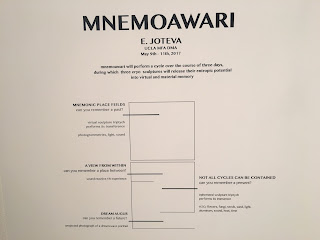
    This Thursday I went to Eli Joteva's solo exhibition -- mnemoawari, which is the second of the cycle over the course of three days. The show was themed on the concepts of memory, dream, and how they connect with past, present and future, through her uniquely made artifacts, and what I saw and felt was absolutely astounding. Picture of the exhibition table I took at the entrance of EDA     In the upstairs area she created three beautiful spheres of ice which were suspended by ropes and frozen in layers. Although to be honest, I did not realize they were iced balls at the first sight, because this is what I saw: Pictures I took of the actual iced balls     Since I went to the show on the second day of its cycle, and these iced balls were melting, the outer iced layers were completely gone, according to Eli herself. However to me this was a good thing because at the time I could have a better look at these artifacts in a unique w...

Desma 9 Midterm

Here is link to my midterm pdf file on google drive. URL: https://drive.google.com/open?id=0BxrlTCyrDWF7ejlLQmFuS0F2R0E

DESMA 9 Week 4 Blog

Image
    Before this week, I honestly couldn't tell you how Medical Technology and Art were in any way related.  But through the lectures and my additional research, I have found that these two ideas converge all over modern and post-modern art as well as many other places.  The first cool thing I found in my research was an entire article on the use of medical technology in art.  The one artist that really stood out to me was Marilene Oliver who experimented with the use of MRI (magnetic resonance imaging) in art. This picture I've included is entitled Family Portrait, and all 4 images are MRI's of an entire family.  I think these images are so unique and interesting, especially when you think about how these items of Medical Technology also serve as eye-appealing art.     However, sometimes people can take these things too far.  For example, the girl Orlan from lecture disfigured and reshaped her body to try and maximize her aesthetic be...

DESMA 9 Event 1 -- Ecocentric Art + Science Symposium: Prophesies & Predictions

Image
    This Friday I attended the Eco-Centric Art + Science: Prophecies and Predictions event. Even though I was only able to stay for the first two hours, I gained a lot from the two lectures given by artist Linda Weintraub and professor James Gimzewski. In the first lecture, Mrs. Weintraub informed us a lot about how modern artists are able to create really innovative artworks by reflecting on the relationships between human, art and nature in the age of industrialization. Professor Gimzewski, on the other hand, presented a very thought-provoking story about a subtle yet inspiring connection between art and science, which is closely related to the topics included in this course. Linda Weintraub during her lecture     In her lecture "WHAT's NEXT? Eco Materialism and Contemporary Art", Mrs. Weintraub talked about several artists and their contribution to neo-materialism through different kinds of art forms, including Gebhard Sengmüller and his "Parallel Image...

DESMA 9 Week 3 Blog

Image
             This week's lectures are all about the convergence of art and robotics. To me, these two seemingly polarizing ideas come together to make a connection which is especially apparent within the medium of film. A good example would be the famous Will Smith movie, iRobot.  Although it received mixed reviews from movie critics, almost everyone could agree on the fact that this action movie also makes you think.  This movie follows the life of Will Smith and his dealings with these creatures of artificial intelligence and it provokes thoughts about things like robotics, humanity, morality, and consciousness.      Walter Benjamin also played a key role in the use of robotics in films.  In the 1930s, he wrote about how films should try and "gain control over technology and its effects" while also creating a sensational experience that goes far beyond an other form of media or consumption.  In modern fi...

DESMA 9 Week 2 Blog

Image
    Making Art From Equations     This week's lecture is about the convergence of Math and Art.  As a significant part, or even "base" of all science, math plays a pivotal role in all aspects of life, even art!  In anything from a detailed drawing, to graphic design, to architecture, math is at work in tandem with art.  Especially nowadays, art is being taken to whole new lengths beyond just a palette and a canvas. Designers are now able to use computers to develop their own unique styles of art that help bring their craft into the technologically advanced 21st century.  This first article i read summed this all up pretty well: "Art is illusion, and transformations are important in creating illusion." These transformations are only made possible by the computers and the mathematics behind the computers that help this art come to life.          I still remember the following TED talk that I came across years ago, ...